You Don’t Know how to Start?

You want to write a book, but you don’t know how to start?

You might need to consider personal time management. Separate tasks or projects under “urgent” – “important” – “necessary” – “desired.” This takes insight, planning, preparation, and promotes efficiency. It also greatly reduces time spent in crisis-management.

Decide what’s needed to accomplish that task. Of all those necessities, which ones are more important? Of those, which ones are mandatory?

Of course, you will have decided on a theme, plot, and story line. You will also need pen & paper, typewriter & paper, or a computer. And it would help if you had a place to write, and time to do it.

However, one of the most important aspects of writing is what I call living your story. Authors who mentally enter the story write with a more balanced emotion, and that gives the story life.

So make your plan. Study your topic, ask for and receive proper mentoring, and pick out a good editor. Why? Editors refine and improve our material by correcting a lot of things we writers miss: errors in spelling, grammar, syntax, and punctuation. They also ensure that ideas flow logically and smoothly.

But you’ll never write the story or book unless you sit down and just start writing. It won’t write itself.

Please keep these thoughts in mind, and …

Write Creatively
Start with What You Know

Sometimes I have a difficult time starting a blog or a story. When that happens, I have a default mode – I start writing about an idea I’ve stored in my “Idea Folder” in my computer, or something I already know about. An event in my life, something I remember or saw recently, a news flash – many things can ignite the writing flame. That heats up the imagination and the story begins to flow.

If I’m writing history, I write what happened. If I’m writing fiction, I feel free to change things around. Sometimes I start with history but the flow changes direction and I revert to fiction. That’s okay.

Let your creativity out of its box and create characters that fit what’s happening in your imagination. The story can be historical, morph into historical fiction, or turn to total fiction – that’s okay. As you “see and hear” the characters floating in your imagination, your emotion will generate energy for the story. Write what you see and hear. You can – and should – always edit later.

So, if you’re having a difficult time thinking of a theme or story line, start with what you know, and …

Write Creatively

Valentine’s Day Special

P&L Publishing and Literary Services is offering a $100 discount as a Valentine’s Day special. If you are writing a book – or are ready to publish one – contact us on our “Get In Touch” or contact page and tell us you read this blog. You’ll be surprised at how little it costs and how quickly we can publish your book. Contact us on or before Leap Day (February 29, 2024) to receive this offer. (https://plpubandlit.org/)

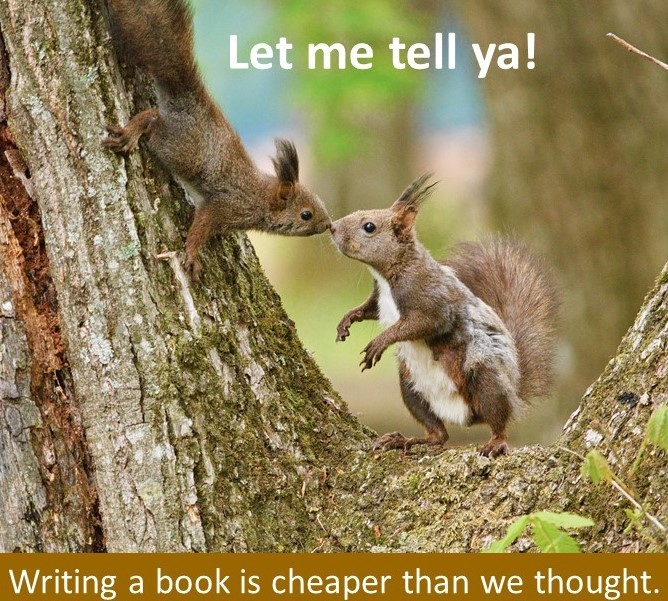
And just as this critter is passing on this information, share this blog with your friends.

Write Creatively

Valentine’s Day Special

P&L Publishing and Literary Services is offering a $100 discount as a Valentine’s Day special. If you are writing a book – or are ready to publish one – contact us on our “Get In Touch” or contact page and tell us you read this blog. You’ll be surprised at how little it costs and how quickly we can publish your book. Contact us on or before Leap Day (February 29, 2024) to receive this offer. (https://plpubandlit.org/)

And just as this critter is passing on this information, share this blog with your friends.

Write Creatively

Write About Your Passion

I suppose that is a goofy way to start this blog, but let’s talk about it in a literary sense.

One of the reasons I had difficulty writing when I was a kid was simple: I had to write about the topics teachers gave me. I wasn’t interested and my writing proved it. But with the help of my 7th-grade teacher, I developed an interest in history. Later, I got interested in several areas of science. Then, the Bible came alive to me in a way I never dreamed possible, and it became my foundation.

With the Bible, history, and science as my passions, the process of writing became not just meaningful, but fun! It was enjoyable because that same passion drove me to read more, and my well of knowledge began filling. Reading and writing became a major direction in my life, but it was the passion – the love of the Bible, history, and science – that motivated me.

However, I still had a difficult time writing what people wanted to read. I didn’t have their passions, and my writing was a little flat. Call it boring! So I decided to write about my own interests. My newspaper columns, my scientific endeavors, my teaching, and my preaching all revolved around the Bible, history, and science. And would you believe it? I had stumbled onto a very important principle, and people wanted more.

Bestselling author Jerry Jenkins said in his blog, The Secret to Compelling Writing, “Write the book you would read. Write it in a way that would keep your interest, and your book will find all the readers you want.”

So I encourage all of you, find your literary passion. Go with it, and …

Write Creatively

Capture your Thoughts

Have you ever had an amazing thought, revelation, or inspiration, but it evaporated into oblivion? Yep, it happens to all of us. But if our mind is working like it’s supposed to, why can’t we remember a simple thought? Quite simply, it’s because so many other things are happening.

You might have heard that we have an average of 60,000-70,000 thoughts being processed through our brain every day, but the real number is probably closer to around 6,500. Nevertheless, at 6,500 thoughts in an 18-hour day, assuming we sleep 6 hours, that is around 360 thoughts an hour. Our mind gets crowded!

I’m not necessarily a creative person, but when an idea does bubble up out of the hidden recesses of my brain, I’ve learned to immediately reach for a pen & paper! Why? Far too many ideas have escaped from my mind and into the stratosphere simply because I didn’t capture them on paper. My dad said quite often, “Paper has a longer memory than you do, so write it down.”   

Please, do not assume that you’ll remember the idea later, because, as dad reasoned, more often than not you will forget. It’s understood that of all the thoughts that flit through your mind, you won’t write about all of them, but the ideas you keep can pay great benefits.

I have a folder in my computer labeled “IDEAS” and I visit it often. Ensconced within are Word files with one idea written in each file, and each file is identified with a word or phrase to remind me of what’s written inside. Having been a writer for several decades, writing about anything and everything, this process has served me well. A number of those ideas have patiently waited in the bowels of my computer for years before I resuscitated them, such as what I’m writing about at this moment.

So, let me encourage you once more: Capture your thoughts. Some will become encouragements to individuals, some will become blogs, and some will become books.

Capture your thoughts when they bubble up to the surface of your mind, and …

Write Creatively

Fulfilling Your Dream of Writing – Step 3

You established your place to write, and are working on developing your writing routine. Today let’s talk about Deciding on a Theme.

Have you ever heard the phrase, “flying by the seat of his pants?” That refers to an airplane pilot who doesn’t file flight plans. He just flies his plane in the direction he thinks he needs to go, and expects to get there. But events outside his control such as inclement weather and physical problems with the plane can generate life-threatening situations. A flight plan can save his life, or at least get him back on track.

There are actually 2 parts of the flight plan: 1) where he wants to go, and 2) how he’s going to get there.

Some people “write by the seat of their pants.” Some of them thrive in it, but some writers flail in confusion because of it. They don’t have a direction, or a theme.

Now, to understand what a theme is, let’s look at that flight plan.

1) Where the pilot wants to go would be the theme (the underlying message the author is trying to convey to the reader), and 2) how he’s going to get there is the plot (the structure that the storyteller uses to show how the events are connected).

Let’s turn it around.

If someone asks you what’s your story about, and you say, “It’s a story about an angry man who robs banks, is arrested, but is befriended by the policeman who arrested him,” that’s the plot of the story. But if you say, “It’s about love overcoming hate,” that’s the theme.

The theme is the central message behind the story. It connects all the major ideas in the book together.

While the plot tells what happens in the story, the theme explains why it happens. It gives meaning to the story. Without a theme, your story is a recording of actions and events, but it doesn’t explain why these actions happen. Most likely you have a plot in mind, but deciding on a theme will help keep you on track.

I’ll see you tomorrow.

Write Creatively