A Blowout!

Have you ever had a blowout? Everything seemed to be going smoothly until … oh, wait a minute. What I’m talking about is a flat tire – not an interpersonal eruption. Both can be heart-wrenching, but the tire blowout is easier to fix. Usually.
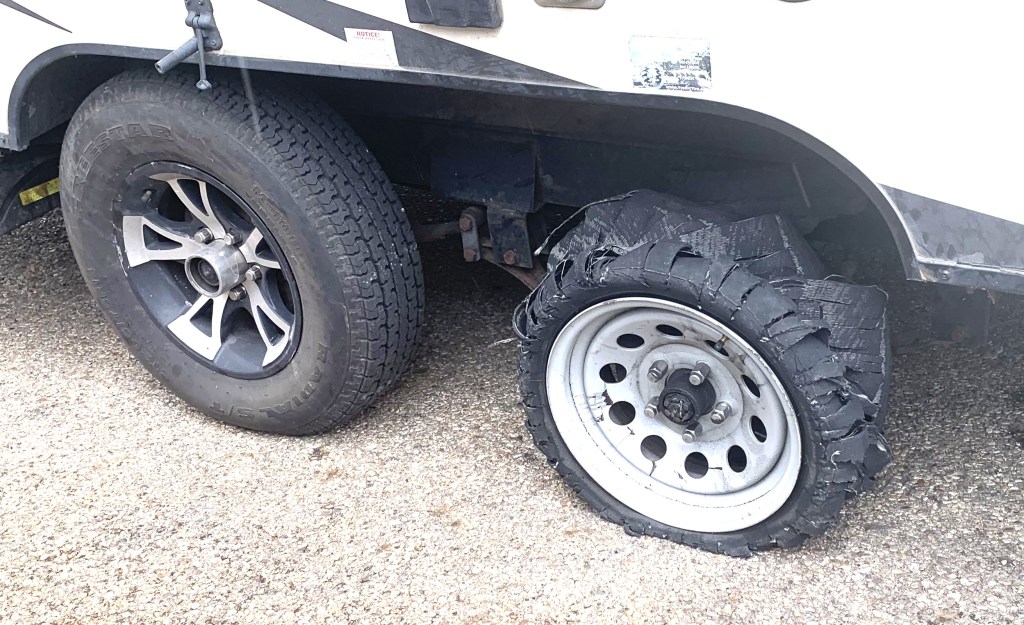
We were in the Columbus, Ohio metroplex when one of the four tires on our trailer blew out. This trailer is Carol’s and my “home-away-from-home,” and we were returning to Arkansas after one of our grandsons was married in Ohio.

There’s no need to get upset about getting a flat tire because having an emotional blowout only causes confusion and hurts relationships. But I was tired and needed a rest, so my daughters advised me to drive to the next freeway exit and into the parking lot of a Shell gas station.

After making two phone calls, they discovered that an automobile tire dealership was only a block away, and they happened to have the trailer tire we needed. Wonderful! The owner managed to squeeze us into their crowded schedule, and we were back on the road in less than three hours. I didn’t get upset, I had a good rest, and we were almost on time as we reached the Cracker Barrel restaurant where we celebrated our younger daughter’s birthday.

It’s much easier to ask for assistance in the middle of a problem than to ask to be forgiven after an emotional blowout. So, if you find yourself in what could be an emotional crisis, try to relax and ask for help. And later, you will be able to remember the situation more clearly, be able to talk about it with a clear conscience with family, and be able to write about it.

And as you write …

Write Creatively.

Actively Listening Enhances Our Writing

In my previous blog I said that learning to actively listen can make us a better writer. Let’s look into it.

In her book, Listening: Its Impact at All Levels on Reading and Other Language Arts (1979), Sara Lundsteen said, “Listening is the foundation for speaking, which is the foundation for reading, which is the foundation for writing.” She taught that since listening is a foundation for writing, active listening can further enhance the author’s writing. I want to follow up on that.

Actively listening to others – rather than passively listening, or interrupting – can increase our vocabulary. An increased vocabulary allows us to give people in our stories a wider range of expression.

Actively listening to others can teach us how others think. Learning how others think allows us to create a greater number of characters, with wider intellectual capacity, and a more complex personality. That, in turn, can give us the potential for a much more interesting story.

But actively listening also helps us personally. I found that when I learned how to actively listen, without interrupting, I began interacting on a more mature level, and people began asking for my thoughts and opinions. By listening, I gained a broader audience and became a better writer.

Listening will help you too, and help you to …

Write Creatively.

The Art of Conversation

On October 5, 2015, Larry Alton wrote: “6 Tips to Rule the Art of Conversation.” Tip #5 is: “Let the other person do the talking.”

On July 21, 2014 Eric Barker listed 7 points of having a good conversation with #5th being: “Great Conversationalists Listen More than Talk.”

Brett and Kay McKay wrote “The Art of Conversation: 5 Dos and Don’ts” on September 24, 2010. #1 in the Dos section is “Listen more than you talk.” And #1 in the Don’ts section is: “Don’t interrupt.”

Yes, we should know how to prepare our thoughts, get our points across, guide the conversation, etc. But the best advice is: Don’t Interrupt.

That’s right: listen to the other person.

In New Mexico, a man came to talk about a problem. After about forty minutes of almost non-stop talking, he said, “Pastor Linzey, I need to get back to work now, but that’s one of the best conversations I ever had. I feel better already. Thank you.”

But I didn’t say much at all.

Interrupting someone as they are speaking is a manifestation of basic immaturity. Interrupting is rude. We expect interruption from a 3-year-old, but we should learn basic courtesy by the time we are eight. Interrupting reveals disregard for the one who is speaking.

One person often asks me a question, interrupts my answer, and forgets that he asked a question. And yes, I get good practice in listening.

As I was growing up, dad used to say, “When you talk, you’re not learning anything. But when you listen, you just might learn something. So practice listening.”

We should learn how to intelligently voice our thoughts. But the number one step in the art of conversation is the art of listening.  Listen to what’s being said so that you can respond intelligently.

James 1:19 (KJV) tells us, “Let every man be swift to hear, slow to speak….”

But there’s one more thought to this blog. Here it is, and I want you to think long and hard about it. “Learning to actively listen will make you a better writer.” Why do I say that?

I’ll explain it in my next blog. In the mean time …

Write Creatively.

What do You Do?

What do you do when you realize that you haven’t kept up on your writing? I just now asked myself that question because with what I’ve got going in life, I realized that I haven’t written a blog since May 8. Let’s see now … that’s 12 days ago!

Should I feel ashamed of myself? Only if I was just goofing around and wasting all my time – which I definitely was not.

So, what do you do? Don’t peak around the corner and wonder who noticed your lack of progress. Do the same thing I’m doing right now: just start writing again. Don’t get in a hurry and try to make up for lost time. Just start writing, and enjoy the process.

And while you’re at it …

Write Creatively.

What’s Your Chosen Writing Genre?

Three days ago, I said “I’ll talk about Documentary Historical Fiction another time.” Well, this is the time.

The online Britannica defines historical novel as a novel that has as its setting a period of history that attempts to convey the spirit, manners, and social conditions of a past age with realistic detail and fidelity to historical fact. The definition is good, but that is rarely what we find.

That presents a problem for truly historical fiction writers because readers may not know whether our writing is credible or not. Allow me to introduce Dr. Maier.

Dr. Paul L. Maier (https://www.paulmaier.com) is the Russell H. Seibert Professor of Ancient History at Western Michigan University and a much-published author of both scholarly and popular works. 

Relating to his works of historical fiction, Dr. Maier said in the preface of The Flames of Rome, “I have not tampered with known facts in retelling it – unlike almost all historical novelist – nor invented characters that could never match the kind who actually lived in this area…. But here as elsewhere in ancient history, yawning gaps in the original sources prevent any telling of the full story. I have tried to fill these in by devising a genre which I call the “documentary novel,” resorting to fiction for such connective material as well as dramatization, dialogue, and sub-plot to flesh out the story and bring its characters to life.”

Every person Dr. Maier named was a real person, but every character he created received no name in his books. Unless noted in the appendix otherwise, every event he described was actual. He constructed “history” only where there was no evidence for an event, but he remained true to life in that time frame.

I’m adding documentary historical fiction to my favorite genre list. That will help me to …

Write Creatively.

What Are Your Preferred Genres?

Bible, science, and history have been my chosen genres for the past 45 years. However, within the past 3 years I adopted Creative Nonfiction, and am considering Documentary Historical Fiction.

The shortest definition of Creative Nonfiction is: a true story well told. Best selling author, mentor, and instructor Lee Gutkind said, “I am often asked: ‘What is creative nonfiction?’ Memoir, for example, personal essay, biography, narrative history, and long form narrative reportage may all fit under the creative nonfiction umbrella. Writers who write creative nonfiction are very different in voice, orientation and purpose. But what they have in common is that they are, in one way or the other, writing true stories that provide information about a variety of subjects, enriched by relevant thoughtful ideas, personal insight, and intimacies about life and the world we live in. And this scope and variety is exactly what makes creative nonfiction significant and, these days, so incredibly popular.”

Creative nonfiction involves descriptive narrative, but we need to be careful not to overdo the verbosity. However, this genre – used correctly – vies for first place with fiction for popularity. Look up Lee Gutkind and learn more.

‘ll talk about Documentary Historical Fiction another time. In the mean time …

Write Creatively.

You Might Want to Know …

One of our readers recently emailed us with a few questions. I want to share the primary question with you because it seems that many people don’t know this bit of info.

Can changes be made to my book after it’s published? And if so, how do we go about it?

The first answer is “Yes. We can modify anything we publish.” Working with us, P&L Publishing and Literary Services, the author never loses ownership of his or her work. Therefore, the author can ask for changes any time … even many years later.

The second answer is also easy. Just send us a document listing what you want to modify, and we’ll make the changes. But please note: we cannot change anything we did not publish.

There most likely will be a fee involved, and the fee will depend on the nature and complexity of the changes.

One of the benefits working with P&L is that we try to make things easy for our authors. When you call, you will talk with a live, breathing, friendly person. Have a great week, and …

Write Creatively.

We are Products of our Decisions

A week ago, a young man, John, affirmed that we (all humans) are products of our environment, and wanted to know my thoughts about it. Before I commented, I wanted to make sure that I understood what he said, and what he meant. I wanted to understand his position before I attempted to help him understand mine. (That’s an application of Stephen Covey’s Principle #5 in his book, 7 Habits of Highly Effective People. I encourage you to read the book.)

After John reiterated his statement and affirmed is belief in it, our discussion proceeded. About 20 minutes later, our conversation ended on friendly terms, and John had changed his mind. He now understands that we are not products of our environments, but products of our decisions. The result of every decision we make is another “building block” in the foundation of our lives. So, make your decisions wisely, and please apply that bit of wisdom to all areas of your life.

But since our topics in these blogs are about writing and publishing, apply it here, too. Decide to be proactive in your writing endeavors. If you want to become an author, or if you are an author and want to get that next book published, you will need to overcome the ever-present hinderances and establish your plan to get it done.

Be gentle and considerate with family and friends as you help them understand your needs in completing your project. And as you proceed …

Write Creatively.

Are You Loquacious?

As a 10-year-old, I was having a difficult time explaining something to my dad. When I finished, he said, “Well, you certainly are loquacious.”

Later in life I learned that some writers are loquacious, but we often use the term verbose – using unnecessary words, filler material that does not help the story. Some time ago, I read a book and told my wife, “This author didn’t have much to say, and he spent a long time proving it.”

Writers – including myself – should not waste potential reader’s time with verbosity.

I’m not suggesting that we limit our words. What I am hinting at is to make our words meaningful. It isn’t the multiplicity of words that carry the story; the story is in the content of the words. We need to cut out the chaff, the fluff, the filler material, and let the readers feed on the meat. That takes time and planning.

Mark Twain understood it and said, “I didn’t have time to write a short letter, so I wrote a long one instead.”

President Woodrow Wilson addressed this subject in 31 words when he was asked to give an impromptu, short talk. “If I am to speak ten minutes, I need a week for preparation; If fifteen minutes, three days; if half an hour, two days; if an hour, I am ready now.”

Don’t be loquacious … I mean, verbose. Make every word count. And be sure to …

Write Creatively.

Happy March 1st

Well, what do you know? Today is special for several reasons. Among the many reasons, it is National Peanut Butter Lover’s Day, Baby Sleep Day, National ‘Dadgum That’s Good’ Day, National Speech and Education Day, and Share a Smile Day.

Oh yes, it also marks the anniversary of when the Continental Congress adopted the Articles of Confederation.

Hmmmmm …. Did I mention that it’s also National Horse Protection Day? Forgive me for the oversight.

I suppose I’ve taken up too much of your day, so I better sign off. Have a great March 1st, share a smile with someone, and …

Write Creatively.