A Blowout!

Have you ever had a blowout? Everything seemed to be going smoothly until … oh, wait a minute. What I’m talking about is a flat tire – not an interpersonal eruption. Both can be heart-wrenching, but the tire blowout is easier to fix. Usually.
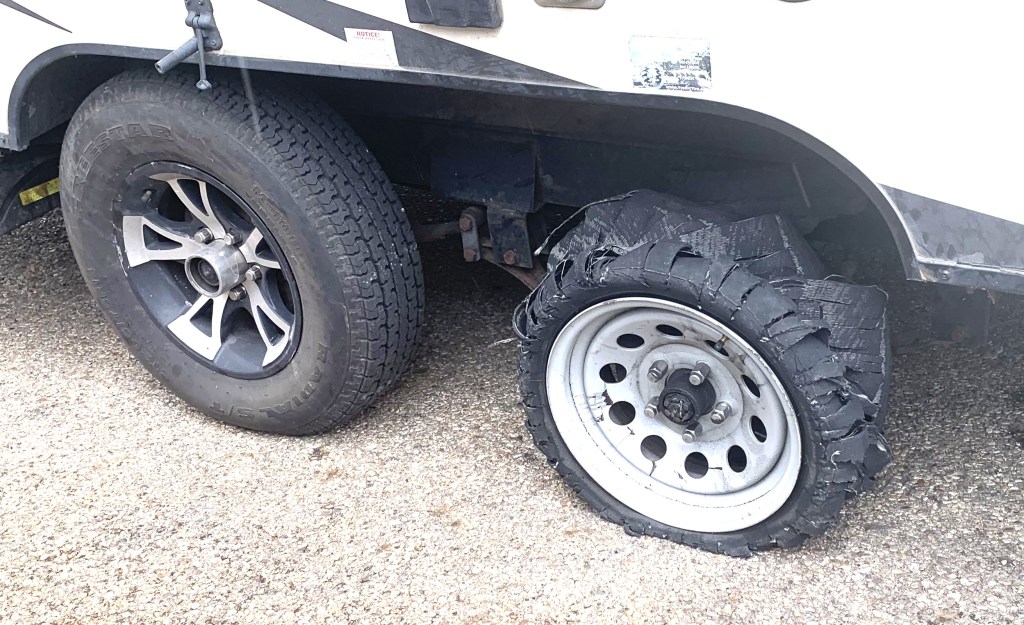
We were in the Columbus, Ohio metroplex when one of the four tires on our trailer blew out. This trailer is Carol’s and my “home-away-from-home,” and we were returning to Arkansas after one of our grandsons was married in Ohio.

There’s no need to get upset about getting a flat tire because having an emotional blowout only causes confusion and hurts relationships. But I was tired and needed a rest, so my daughters advised me to drive to the next freeway exit and into the parking lot of a Shell gas station.

After making two phone calls, they discovered that an automobile tire dealership was only a block away, and they happened to have the trailer tire we needed. Wonderful! The owner managed to squeeze us into their crowded schedule, and we were back on the road in less than three hours. I didn’t get upset, I had a good rest, and we were almost on time as we reached the Cracker Barrel restaurant where we celebrated our younger daughter’s birthday.

It’s much easier to ask for assistance in the middle of a problem than to ask to be forgiven after an emotional blowout. So, if you find yourself in what could be an emotional crisis, try to relax and ask for help. And later, you will be able to remember the situation more clearly, be able to talk about it with a clear conscience with family, and be able to write about it.

And as you write …

Write Creatively.

Actively Listening Enhances Our Writing

In my previous blog I said that learning to actively listen can make us a better writer. Let’s look into it.

In her book, Listening: Its Impact at All Levels on Reading and Other Language Arts (1979), Sara Lundsteen said, “Listening is the foundation for speaking, which is the foundation for reading, which is the foundation for writing.” She taught that since listening is a foundation for writing, active listening can further enhance the author’s writing. I want to follow up on that.

Actively listening to others – rather than passively listening, or interrupting – can increase our vocabulary. An increased vocabulary allows us to give people in our stories a wider range of expression.

Actively listening to others can teach us how others think. Learning how others think allows us to create a greater number of characters, with wider intellectual capacity, and a more complex personality. That, in turn, can give us the potential for a much more interesting story.

But actively listening also helps us personally. I found that when I learned how to actively listen, without interrupting, I began interacting on a more mature level, and people began asking for my thoughts and opinions. By listening, I gained a broader audience and became a better writer.

Listening will help you too, and help you to …

Write Creatively.

The Art of Conversation

On October 5, 2015, Larry Alton wrote: “6 Tips to Rule the Art of Conversation.” Tip #5 is: “Let the other person do the talking.”

On July 21, 2014 Eric Barker listed 7 points of having a good conversation with #5th being: “Great Conversationalists Listen More than Talk.”

Brett and Kay McKay wrote “The Art of Conversation: 5 Dos and Don’ts” on September 24, 2010. #1 in the Dos section is “Listen more than you talk.” And #1 in the Don’ts section is: “Don’t interrupt.”

Yes, we should know how to prepare our thoughts, get our points across, guide the conversation, etc. But the best advice is: Don’t Interrupt.

That’s right: listen to the other person.

In New Mexico, a man came to talk about a problem. After about forty minutes of almost non-stop talking, he said, “Pastor Linzey, I need to get back to work now, but that’s one of the best conversations I ever had. I feel better already. Thank you.”

But I didn’t say much at all.

Interrupting someone as they are speaking is a manifestation of basic immaturity. Interrupting is rude. We expect interruption from a 3-year-old, but we should learn basic courtesy by the time we are eight. Interrupting reveals disregard for the one who is speaking.

One person often asks me a question, interrupts my answer, and forgets that he asked a question. And yes, I get good practice in listening.

As I was growing up, dad used to say, “When you talk, you’re not learning anything. But when you listen, you just might learn something. So practice listening.”

We should learn how to intelligently voice our thoughts. But the number one step in the art of conversation is the art of listening.  Listen to what’s being said so that you can respond intelligently.

James 1:19 (KJV) tells us, “Let every man be swift to hear, slow to speak….”

But there’s one more thought to this blog. Here it is, and I want you to think long and hard about it. “Learning to actively listen will make you a better writer.” Why do I say that?

I’ll explain it in my next blog. In the mean time …

Write Creatively.

Where do I start?

Sometimes when we sit down to write, we get lost and wonder, “Where do I start?”

One answer: Choose a natural starting point.

When we read a good novel, it all seems to unfold so naturally from the first sentence, so why do we have a difficult time getting started? We need to remind ourselves that famous authors are faced with the same problem. Don’t laugh now, but they have editors to help them, too.

Think about real life. No significant episode in your own life sprung up from nothing; things happened that shaped the current event, and things happened afterward as a result of it. Think about your story in the same way. The characters have pasts and futures (unless you plan to kill them). Places, too, have pasts and futures. Therefore, every good storyteller jumps into his story midstream. Knowing this can help you relax about picking a starting point.

For example, I’m writing about Abraham, and I start with him as an adult in the desert with his camel when God speaks to him. Abe begins mulling over world events and planning his escape from Ur of the Chaldees without being caught. With that setting as my anchor, I build the story.

If you’re unsure where to begin, pick a scene you know you’re going to put in—you just don’t know where yet—and start writing it. You might discover your Chapter One right there. And even if you don’t, you’ll have story material for that scene when the time comes.

Or……

Write several character sketches. You need them anyway, and they’re great warm-ups for Chapter One. Ask yourself: What will this character be doing when we first meet him? Write it. Again, you might find yourself writing Chapter One…or Chapter three. But start.

Your could even do a Chapter-One-Only brainstorm and see what comes out.

You can write a great story starting from any of several places. But wherever it is, start with action! That will help you to …

Write Creatively.

Tip #3

James Michener read many other author’s writings. Not that he wanted to copy them – not at all. But reading other’s writings helps us establish our literary direction and form our own voice.

Tip #3. “I think the crucial thing in the writing career is to find what you want to do and how you fit in. What somebody else does is of no concern whatever except as an interesting variation.”

Learn to write well. You must study and practice, but be your own person. Develop your own style. Excellent writing normally does not materialize overnight. As one mentor suggested: write – write – write – and keep on writing.

So, go ahead and dream about becoming a famous writer, but invest the time to help you reach your goal. And don’t forget to learn how to …

Write Creatively.

What Are Your Preferred Genres?

Bible, science, and history have been my chosen genres for the past 45 years. However, within the past 3 years I adopted Creative Nonfiction, and am considering Documentary Historical Fiction.

The shortest definition of Creative Nonfiction is: a true story well told. Best selling author, mentor, and instructor Lee Gutkind said, “I am often asked: ‘What is creative nonfiction?’ Memoir, for example, personal essay, biography, narrative history, and long form narrative reportage may all fit under the creative nonfiction umbrella. Writers who write creative nonfiction are very different in voice, orientation and purpose. But what they have in common is that they are, in one way or the other, writing true stories that provide information about a variety of subjects, enriched by relevant thoughtful ideas, personal insight, and intimacies about life and the world we live in. And this scope and variety is exactly what makes creative nonfiction significant and, these days, so incredibly popular.”

Creative nonfiction involves descriptive narrative, but we need to be careful not to overdo the verbosity. However, this genre – used correctly – vies for first place with fiction for popularity. Look up Lee Gutkind and learn more.

‘ll talk about Documentary Historical Fiction another time. In the mean time …

Write Creatively.

We are Products of our Decisions

A week ago, a young man, John, affirmed that we (all humans) are products of our environment, and wanted to know my thoughts about it. Before I commented, I wanted to make sure that I understood what he said, and what he meant. I wanted to understand his position before I attempted to help him understand mine. (That’s an application of Stephen Covey’s Principle #5 in his book, 7 Habits of Highly Effective People. I encourage you to read the book.)

After John reiterated his statement and affirmed is belief in it, our discussion proceeded. About 20 minutes later, our conversation ended on friendly terms, and John had changed his mind. He now understands that we are not products of our environments, but products of our decisions. The result of every decision we make is another “building block” in the foundation of our lives. So, make your decisions wisely, and please apply that bit of wisdom to all areas of your life.

But since our topics in these blogs are about writing and publishing, apply it here, too. Decide to be proactive in your writing endeavors. If you want to become an author, or if you are an author and want to get that next book published, you will need to overcome the ever-present hinderances and establish your plan to get it done.

Be gentle and considerate with family and friends as you help them understand your needs in completing your project. And as you proceed …

Write Creatively.

Happy March 1st

Well, what do you know? Today is special for several reasons. Among the many reasons, it is National Peanut Butter Lover’s Day, Baby Sleep Day, National ‘Dadgum That’s Good’ Day, National Speech and Education Day, and Share a Smile Day.

Oh yes, it also marks the anniversary of when the Continental Congress adopted the Articles of Confederation.

Hmmmmm …. Did I mention that it’s also National Horse Protection Day? Forgive me for the oversight.

I suppose I’ve taken up too much of your day, so I better sign off. Have a great March 1st, share a smile with someone, and …

Write Creatively.

Why do you like to write?

What compels you to write? Is it fun? An obsession? An adventure? An escape? I asked a group of people why they wrote, and here are just a few of their responses.

Writing helps me cope with stress.

Writing allows me to go to anywhere I want to go with no restrictions.

Writing allows me to create other worlds, and kind of live in them.

Writing allows me to safely express my thoughts, worries, and anxieties.

I enjoy writing because I find fiction more interesting than the real world.

I write poetry because it helps me connect to my artistic side.

I write to give people a good story to read.

When one of the men asked me why I liked to write, I told him I write to teach about life. Among other things, that includes topics related to history, science, the Bible, humor, and philosophy.

There are hundreds of reasons people write. Why don’t you interview yourself and find out why you like to write. The answers might help you learn to improve your skill. And as you improve, always …

Write Creatively

Learn from Others, but Be Yourself

Babies learn about speech by listening. They learn to talk by imitating. They get good at conversation by practicing. Is there a lesson here for writers? I think so.

We learn about writing by reading. We learn to write by imitating. We get good at it by practicing. Does that sound too simple? Well, if I could reduce it any further, I would.

I’ve heard it said, “Learn from the best, but don’t copy them.” I agree, but I modify it this way, Read, study other writers, and learn all you can. But when it’s your turn to publish your work, don’t copy someone else. Be yourself.

Years ago, my dad said, “My mentors at the writer’s guild told me that I have to write what people want to read. And I have to write it a certain way or I’ll never sell much. What do you think?”

I didn’t want to give advice that conflicted with his mentors because there was some truth in their statements. But they missed an important piece of the puzzle.

After a minute or so, I responded. “Dad, they have great advice if your goal is to make a paycheck. But my advice is to write your passion, about what’s in your heart and mind. But write it well! Learn from them, polish your style, but be yourself.”

How did he do? A few years later he told me that his books sold very well, and he was happy for the freedom of expression I gave him.

So, learn from the best, but don’t try to copy their style. Be yourself, and …

Write Creatively